By Captain Richard Morris, Managing Director, Australian Superyachts Pty Ltd
I know first-hand what it takes to make an Olympic superyacht program work.
For the Sydney 2000 Olympic Games, I managed the operational demands of the Olympic Visiting Vessel Program, helping coordinate the services and arrangements needed to receive and support an international fleet. The work involved complex logistics, multiple stakeholders and significant obstacles, but it demonstrated what can be achieved when the program is properly managed and the details are addressed early.
That experience is directly relevant to Brisbane 2032. I understand the operational challenges, the expectations of international yacht owners and captains, and the importance of giving government and industry the confidence to commit to a coordinated plan well ahead of the Games.
My view, after twenty-six years, is simple. Sydney got its Olympic superyacht program right, and because it did, Australia’s superyacht industry entered a boom of about two and a half decades that the whole industry shared. I believe that if we had got it wrong, the industry here would be much smaller today, or would have started years later than it did.
Before I turned up
Let me clear one thing up first: the superyacht program was not my idea. The Waterways Authority of NSW (later NSW Maritime, now part of Transport for NSW) started on it around 1997, when the phone began ringing with owners asking where they could park a 60-metre superyacht for the Olympics, and the honest answer was “nowhere”.
By 1998 Paul Robinson, the Authority’s General Manager Business Services, was already telling the industry what Sydney planned, and the Authority had a stand at the Monaco and Fort Lauderdale Boat Shows promoting the Olympics with the marine export group AIMEX.
That year SOCOG paid Arthur Andersen to work out whether any of this made sense. Its July 1998 report, Super Yacht Accommodation: Assessment of Supply, Demand and Economic Benefits, reckoned around 100 superyachts might want a Sydney berth for the Games if the right facilities existed, against 66 suitable berths in the whole harbour. It modelled vessel spending alone at A$29 million to A$83 million during the Olympic period and A$117 million to A$235 million over the following decade (net present values), and it suggested that about 20 permanent berths would do the job once the circus left town. To their credit, the consultants were candid that nobody really knew, because there was no superyacht industry in the South Pacific to measure, and their numbers rested on conversations with industry contacts rather than hard data. What they were clear about was the condition: the demand and the benefits would follow if Sydney offered berths of world standard, in one or two places, run by people who understood superyachts, and if owners and captains heard about it in time. That was the test, and it is the one we set out to pass.
What struck me, rereading the report, is how closely it read like a checklist for success. It recorded formal requests from six major sponsors and two national Olympic committees, for yachts from 27 to 114 metres. It said captains plan their circuits up to two years ahead and would want firm berthing details before the end of the 1998 Mediterranean season. It argued that experienced superyacht operators should have a primary role in running the marina, the provisioning and the owner events, and it warned that quarantine rules for ships’ stores and the regulatory barriers to entering Australian waters could hold the industry back. The harbour study it drew on named Rozelle Bay as the ideal permanent site, with 20 long-term berths and room for up to 40 during the Games. Sydney did not hit every date the report asked for, but it delivered the standard the report asked for, and in my view that is why the yachts came and why they kept coming.
The Authority decided to build a purpose-built superyacht marina at Rozelle Bay anyway, and run it as a government business enterprise. That took nerve, and the nerve was theirs.
How a yacht captain ended up in government
In June 1999 I swallowed the anchor. After fourteen years at sea, the last seven commanding superyachts from 41 to 64 metres, I came home planning to open Sydney’s first dedicated superyacht agency, Sydney Superyacht Services (which later evolved into Australian Superyachts). Martin Redmayne from The Yacht Report ran a small item about it. Paul Robinson read it and rang me. A week or so later, at a boat show breakfast, I won the lucky door prize, presented by the Authority’s chief executive, Warwick Watkins. I told him it was an omen. He signed off my appointment shortly afterwards.
In July 1999 I headed a three-person Superyacht Management Team on a fifteen-month contract that would end with the Games. I described the job to one captain as “encouraging yachts to come to Sydney, ensuring that the facilities here are world class, and that the services provided to the yachts when they are here are second to none.” To another I admitted I had been hired as the government’s superyacht “expert”, and added “(laugh)”. The fifteen-month contract turned into ten years…
Building a marina for people who expect everything
The plan was 27 berths in two stages: ten Millennium berths for New Year’s Eve 1999, then seventeen Olympic berths. My job was to stop the marina being designed by people who had never run a superyacht. I polled chief engineers I knew around the world about water, power and sewage. On the last point, my summary from one of them was “lots of it, mate”, and Sydney Harbour was a strict no-discharge zone, so every berth got a vacuum pump-out. I specified shore power of up to 400 amps, modelled on the biggest yacht we expected, plus five phone lines, an ISDN line and cable TV at every berth. The golf buggies took longer to get approved.
Stage one was finished in November 1999, on time and on budget. First in was the 47-metre Sally Ann, on the weekend of 20 November. We met her at the Heads, brought her in and handed the crew a welcome pack, local information and cold beer. Her captain said he had “never been met at a marina by the staff with such a range of services” and that it was the best shore power he had found in a year and a half. Ilona and Dreamtime followed, five yachts used the berths over New Year’s Eve, and the marina took more than A$150,000 before anyone had heard of it.
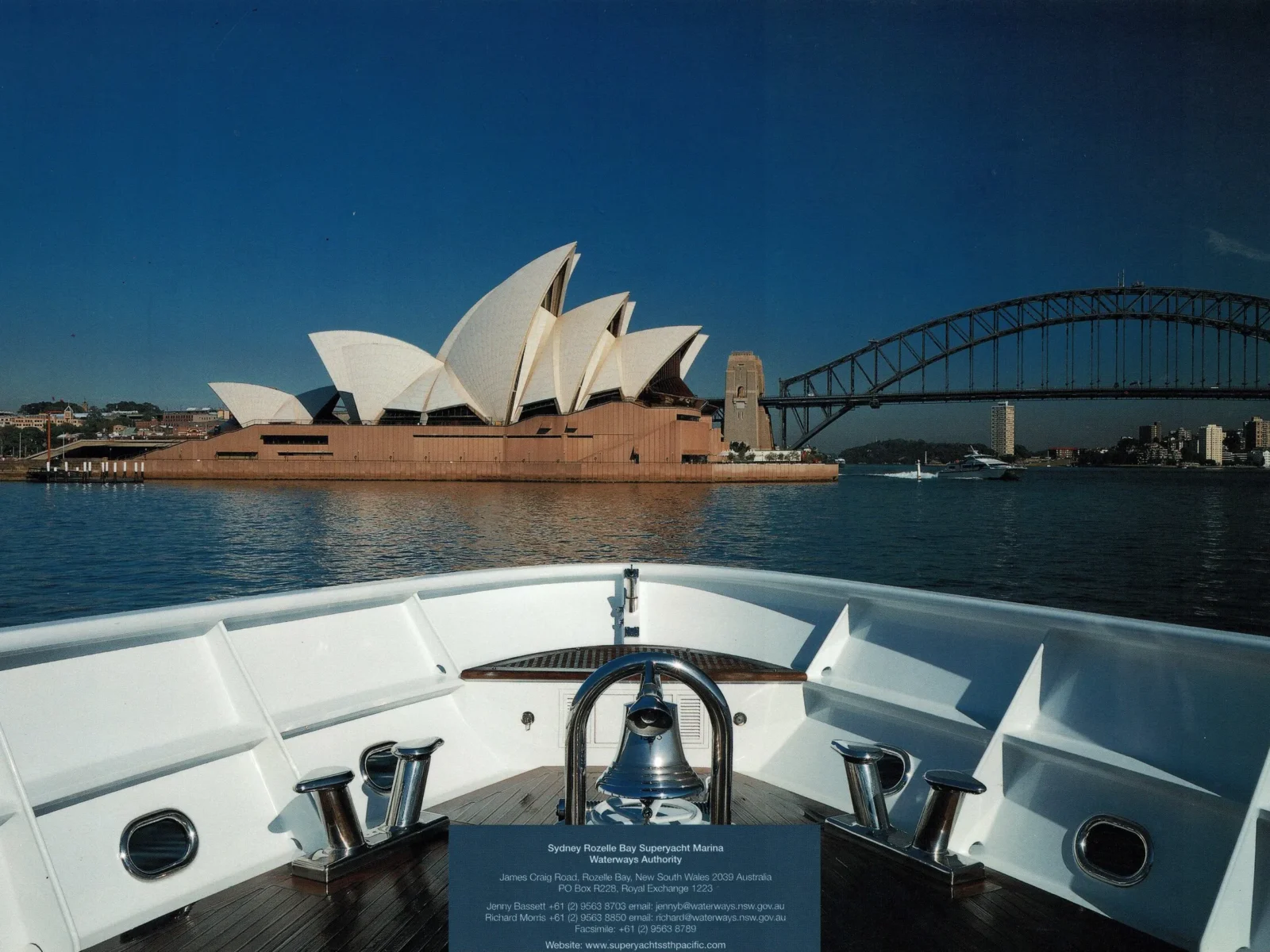
Stage two was approved in December 1999, on the strict condition that enough yachts actually paid. Twelve had. Bellingham Marine built the Olympic berths on heavy-duty floating concrete; they were in the water by autumn 2000 and the land side was finished by August. As built, the marina had 20 large berths for yachts up to 75 metres, sixteen stern-to a floating pontoon and four on the hard dock, plus 20 smaller berths. The Authority billed it as the largest purpose-built superyacht marina in the Southern Hemisphere, which was true, partly because it was more or less the only one. The budget was A$2.7 million and the Authority spent a little over A$2 million, which may be a first for an Olympic project.
Arthur Andersen said twenty permanent berths. We built twenty. Somebody in a suit got one right.
Selling a harbour at the bottom of the world
Try asking a billionaire to give up August in the Mediterranean and sail halfway round the planet for a two-week sporting event. We called our answer “destination marketing”, and we reckon we were the first in the superyacht industry to start promoting a destination rather than a product or service.
It meant an email list that grew from about 400 to 1,000 industry contacts, a 3,500-word survival guide for captains in The Yacht Report, stands at Monaco, Palma and Fort Lauderdale, a CD-ROM (it was 2000), and two trips to Auckland during the America’s Cup, where we handed every yacht a pack with our brochure and every Customs, Immigration and Quarantine form they would need, then poured them drinks at the Australian Consul General’s residence.
From the archive
The original marketing material, scanned from the author’s copies. Click a cover to open the PDF.
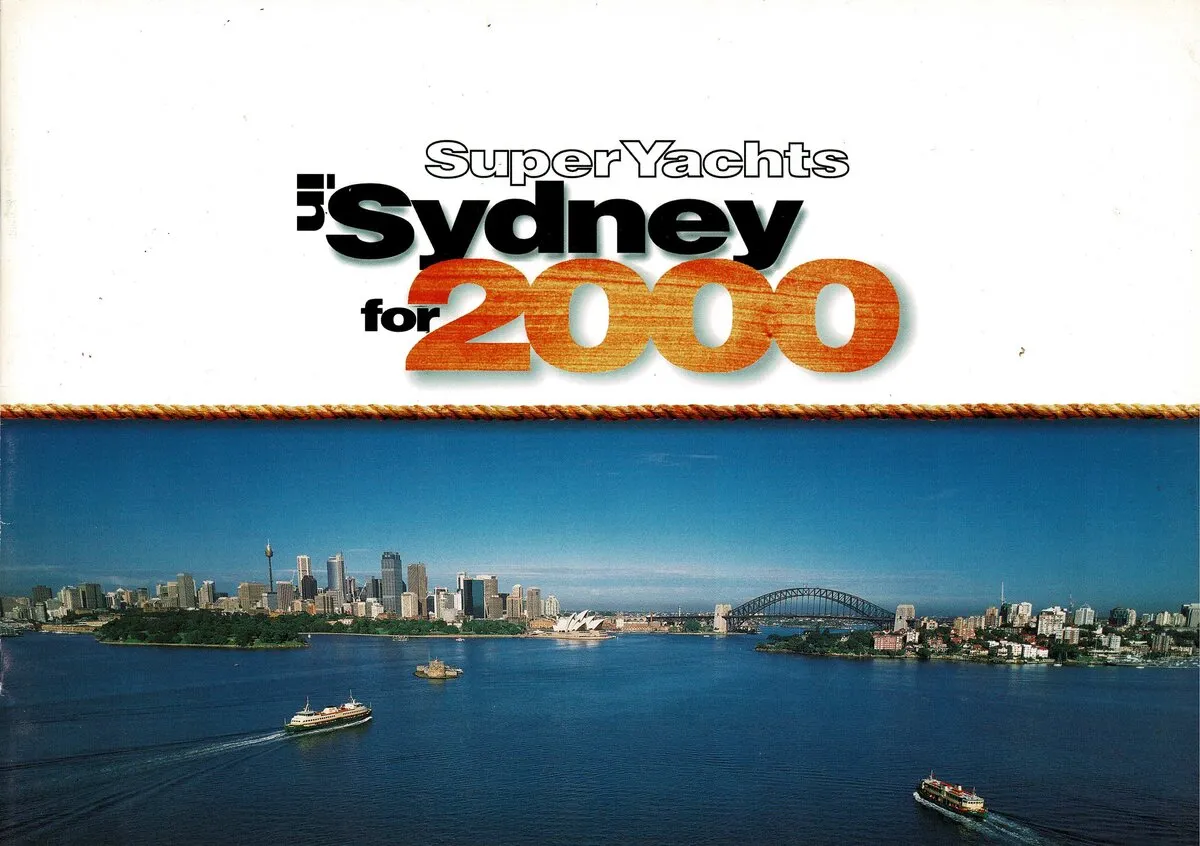
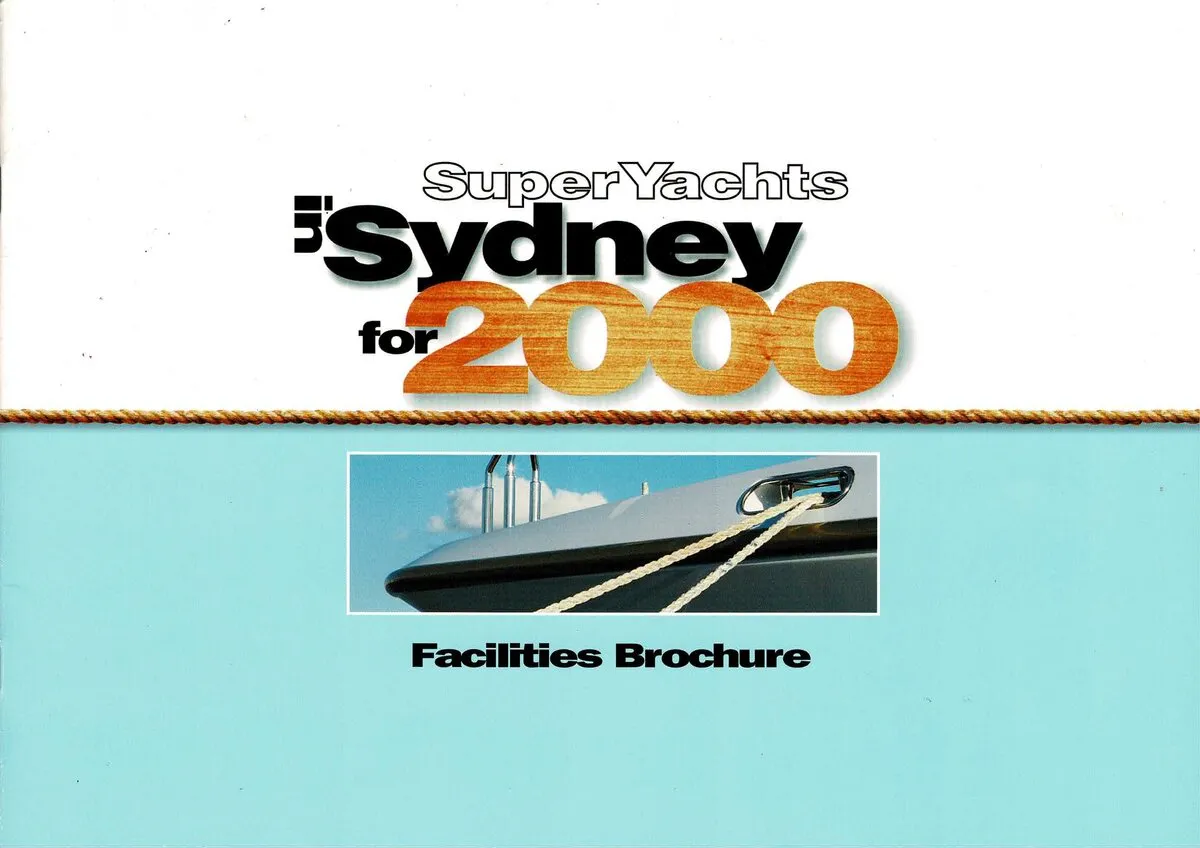
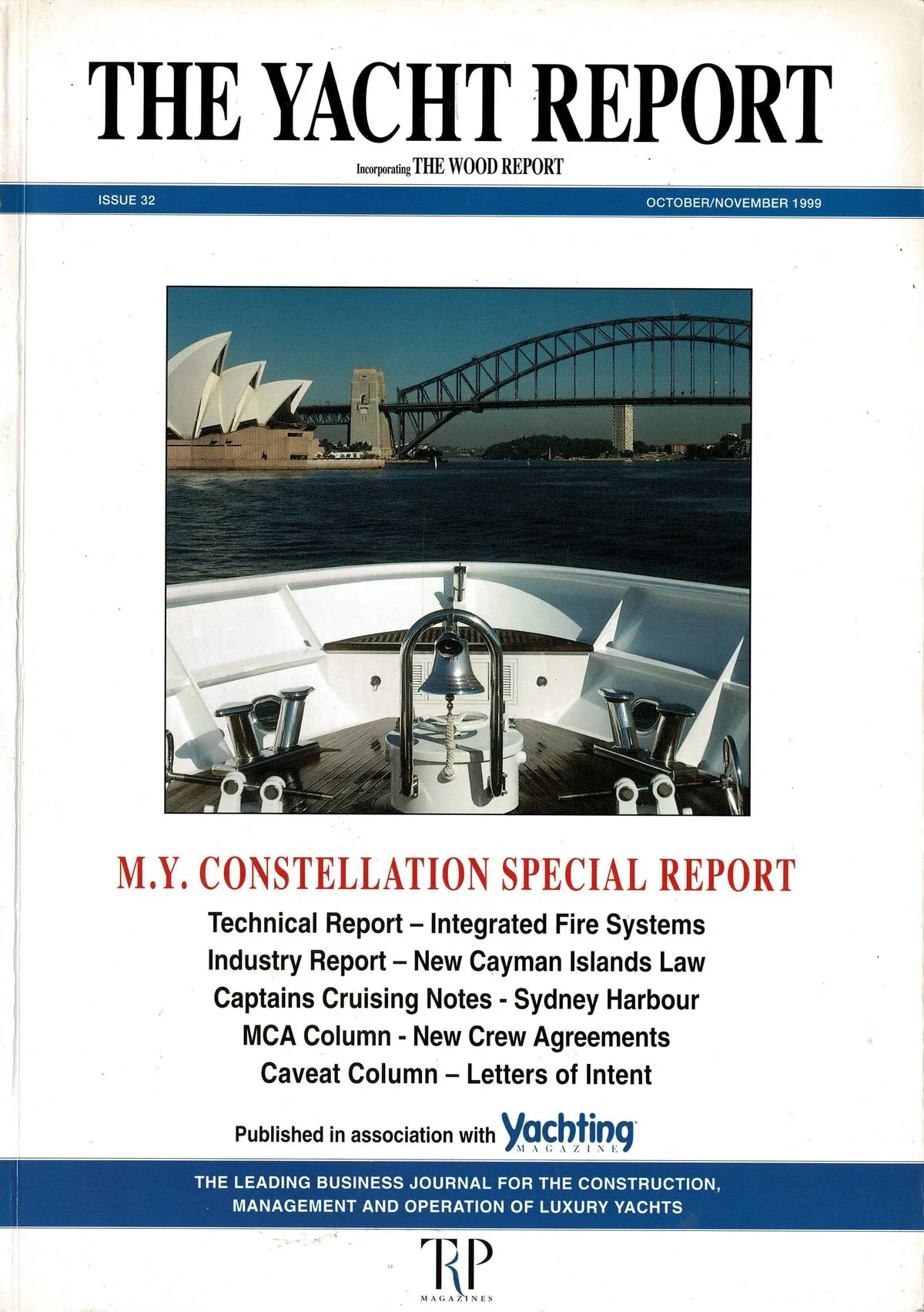
On paper it worked beautifully. Registered interest went from 60 owners in August 1999 to 70 a month later, and by May 2000 the Authority was quoting more than 160. Converting interest into money was another matter. Shipping a yacht out cost around US$250,000 one way, so I leaned on United Yacht Transport until it scheduled a Dock Express from Toulon and Port Everglades to arrive in Sydney at the end of July 2000. A good share of our early bookings came because of that ship.
We priced the Olympic berths at a flat US$50,000 for September and October, roughly what Auckland charged during the Cup, and below the US$70,000 for 40 days that the Arthur Andersen report said Barcelona had charged at the 1992 Games. The owners of smaller yachts pointed out, reasonably, that they were paying the same as a 70-metre ship. In May 2000 we switched to pricing by length, and some quotes fell by more than half.
Myriad obstacles
The biggest problem was the calendar. The Games landed at the end of the Mediterranean summer season, when every charter yacht worth having was booked solid. As I wrote at the time, if the Olympics had been held in November, the situation would have been vastly different.
Then there was Customs: a foreign yacht that took paying guests in Australia faced duty and sales tax of around 27 per cent. In October 1999, as a result of our representations to them, Customs granted an Olympic concession for yachts with a demonstrable connection to the Games, which was excellent news for the owners who hadn’t already given up and gone to the Caribbean.
Quarantine wanted stores landed or bonded, a problem Arthur Andersen had flagged back in 1998, noting that big yachts can carry up to a year’s supplies. The clearance underneath the ANZAC Bridge capped masts at about 28 metres, which ruled out most of the big sailing yachts. The EPA, freshly green for the Games, was patrolling for anything that went over the side. On jetskis which had been recently banned on Sydney Harbour, I had to tell one captain that the rules would not be relaxed, because “everybody hates them here.”
The owners themselves were their own category of obstacle. When word leaked from New Zealand that two of the most famous yachts afloat were heading our way, their managers declared an immediate gag order, and from then on nobody at Waterways named an owner, even to each other. One owner wanted to anchor off his own waterfront for New Year’s Eve, until the Harbour Master pointed out he would be sitting on a submarine cable.
We won a few. I got the Authority to let visiting tenders run without NSW registration if their crews held equivalent tickets, on the grounds that otherwise we would have sixty unhappy skippers on the doorstep. Before the Games the Authority, the Harbour Master and Sydney Ports agreed that superyachts would get a free pilotage and induction service instead of paying for a Sydney Harbour sea pilot. The pilot was me.
The press, meanwhile, had decided we were a disaster. In May 2000 the Australian Financial Review ran “80 superyachts to give Sydney a wide berth”, and a trade paper predicted the marina would be less than half full. Some yachts did pull out: thirteen that had booked at Rozelle Bay never arrived, thanks to an onboard fire, owners’ illness, shipyards running a year late and a coup in Fiji. You cannot make this stuff up.
The Games
The first overseas superyacht turned up on 31 July 2000. It was Itasca, a 55-metre converted ocean tug, which says something about the market. Boadicea, at 71 metres the biggest, took a metre off the top of her mast and threaded the old Glebe Island Bridge with about a metre to spare on each side. I didn’t breathe for most of it.
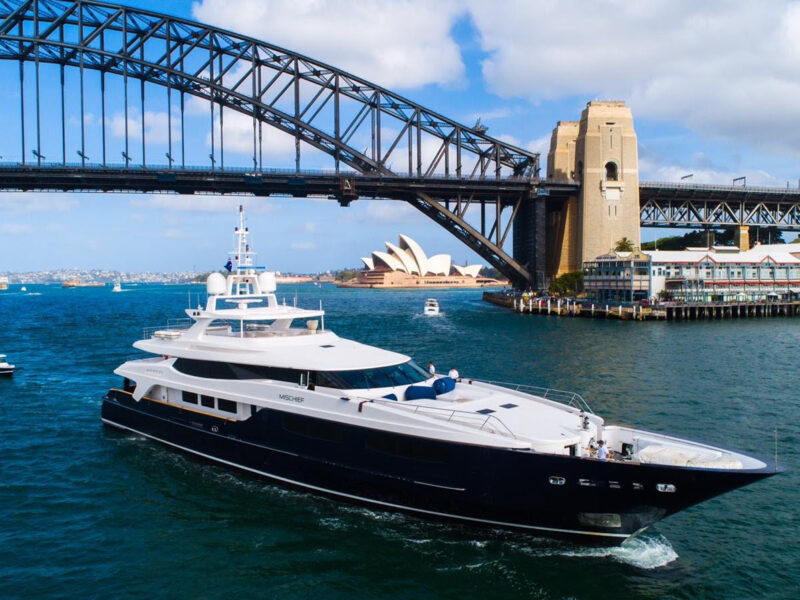
When the Games opened there were around 40 superyachts of 24 metres and over on Sydney Harbour, more than the city had ever seen. Eleven were with us at Rozelle Bay; the rest were spread around Rushcutters Bay, Woolloomooloo, Pyrmont, Garden Island and elsewhere. The fleet included Boadicea, Aviva, Arctic P, Charade, Itasca, Liberty, Blue Gold, Freesia, My Way, Galaxy, Loenen, Dreamtime, Sea Quell and Cambria.
My job was to be the one phone number that solved everything. I piloted yachts in from sea, had Customs and Quarantine waiting on the dock, and talked AQIS into letting crews keep stores they would otherwise have had to bin. I got aviation approval for one owner’s helicopter to fly off the harbour, after establishing that it was quieter than most of the helicopters already buzzing over it. I booked hire cars, guest boats and built a tender wharf at Homebush Bay for owners who did not do public transport. One yacht’s wish list included gold-foil-wrapped chocolates to represent medals, a Priscilla, Queen of the Desert themed dinner with a drag performance on board, a didgeridoo player and a Jimi Hendrix impersonator. Another owner’s onboard garden needed real turf, until it turned out the dog wasn’t coming, at which point Astroturf would do.
On 13 September we staged the first superyacht regatta Sydney Harbour had seen, with the Royal Sydney Yacht Squadron, the Cruising Yacht Club and the Royal Motor Yacht Club, and a parade past the Opera House. Liquidity, our dockside bar and restaurant built in a shed, became the place to be seen for a fortnight and hosted many famous celebrities including Tom Cruise, Nicole Kidman, Russell Crowe and Muhammad Ali.
The captains were kind. Charade’s wrote that the team “supplied service and support far beyond my expectations and above those usually on offer at the best facilities in the world.” Boadicea’s wrote that his owners had arrived “more than doubtful” and left “delighted”, and added: “whilst it was not an Olympic event, you would have taken another Gold Medal for Australia if judged.” When I forwarded that one, our media officer replied: “enough already! do you write this stuff for them?” I didn’t. The captain of the 60-metre Aviva reckoned his yacht spent about A$230,000 in two months on berthing, food, tickets, tradesmen and equipment, and described her modestly as “basically a family boat”.
The morning after
My contract ended with the closing ceremony. Unfortunately for my retirement plans, several yachts refused to leave. Aviva went away and came back for three months; Galaxy, Loenen and Shilo stayed until February 2001; Ultimate cruised the east coast for nearly two years. The government needed someone to look after them, so I stayed on.
Then the hangover. After the Games, the marina had a slow start. In the 2001-02 financial year only six superyachts over 100 feet visited Rozelle Bay, not helped by world events in September 2001… The seagulls preferred our plastic owl to the empty berths, and I advised management that “the best solution to prevent birds is more boats.” The superyacht cost centre lost money in each of its first few years.
The fix came while I was piloting the 52-metre Feadship Battered Bull down the harbour in 2002. I asked her captain why they were only staying a week. They had to get to Auckland quickly, he said, so Caterpillar could rebuild their generators. I mentioned that Caterpillar had a branch in Sydney. He didn’t know. She stayed six months and spent a fortune, and I realised Sydney’s problem was not facilities but the fact that nobody knew about them.
With the Authority behind me I pulled the main service companies into an alliance, Superyachts Sydney, launched in 2002 with ADI, MTU Detroit Diesel, Superyacht Solutions, Barwil Agencies and Gough & Gilmour (Caterpillar). Its first job, a refit of the 48-metre Vava in Newcastle, was worth more than A$1 million to NSW. By 2005 fourteen big yachts had refitted in Sydney and Newcastle, about A$20 million of work that the NSW State Chamber of Commerce reckoned was worth more than A$90 million to the state.
From 2004 the marina made money, and by 2007 became very profitable. In the summer of 2006-07 about 45 superyachts came to Sydney, finally beating the Olympics, and by the late 2000s the NSW Government was reporting around 45 visits a year and roughly $50 million annually in direct spending.
We opened Campbells Cove next to the Opera House for yachts too tall to get under the Sydney Harbour Bridge, which turned out to be the most photographed berth in the country. In 2006 the alliance became the NSW Superyacht Industry Association, with more than 50 members, and I served as vice president and then executive director. Athens, getting ready for 2004, and Toronto’s 2008 bid team both rang to ask how we had done it.
The marina’s success also gave NSW Maritime the confidence to release the Rozelle Bay Master Plan in 2002. Over the following years that plan delivered Sydney City Marine, dry stack boat storage and a cluster of waterfront contractor bases, all built around the superyacht marina as the first stage and centrepiece of the precinct. Rozelle Bay became a standout example of what the public and private sectors can achieve together.
The marina had been built on a temporary development approval for the Games, which is the government’s way of saying it might be knocked down at any moment. In 2007 a journalist asked whether it was about to be sold, and he was right: I was already working on the sale documentation. In April 2008 I moved into a strategic projects role to prepare it for sale to the private sector, and in June 2009, exactly ten years after signing a fifteen-month contract, I left with the job done. NSW Maritime’s Chief Executive wrote that under my management the marina had “developed into a successful government business enterprise”, that I had guided “some 150 superyachts from the sea to their berth and around the harbour” and that I was moving on “after the successful completion of his projects.” It runs today as Sydney Superyacht Marina, and more than 200 superyachts have used it since 1999.
Why doing it right mattered
Mark the Sydney 2000 Olympic Games against Arthur Andersen’s homework and the result is a good one. The report put demand at around 100 berths if conditions were right, and about 40 superyachts came, more than the harbour had ever seen, at the end of the Mediterranean season and a long way from home.
The broader Olympic tourism forecast was less fortunate. A January 1999 Arthur Andersen study with the Centre for Regional Economic Analysis promised the Games would boost Australia’s economy by A$6.5 billion over the twelve years to mid-2006, mostly through tourism, and after September 11 later modelling found the tourism boom never arrived.
The superyacht legacy did better than anyone forecast. Twenty berths were built, as recommended, and within six years they were full. Visits fell after 2001 like everything else, then recovered and passed their Olympic peak, because Sydney had something left over after the party: a marina, a harbour that knew what to do with a 70-metre yacht and a bunch of companies who had worked out there was money in it.
That is the point of this whole story. Sydney did not just fill a marina for a fortnight. It did the job properly, from the vacuum pump-outs to the pilot on the harbour, and the captains’ letters at the time say as much. A service industry that did not exist in 1999 grew up around the yachts, and yards, suppliers, agents, crew and marinas shared in the work.
I believe that if Sydney had botched it, owners and captains would have written Australia off, and the boom that followed would have been far smaller, or would have come much later.
The industry it started
Every serious account of the Australian superyacht industry starts at Rozelle Bay. Sydney 2000 proved three things: international superyachts would come to Australia, government and industry could clear the regulatory path for them, and it was worth the trouble.
Today it is a proper industry. Superyacht Australia puts its contribution at around $8.6 billion a year to the national economy, more than $4.6 billion of it in Queensland, supporting over 17,000 Queensland jobs. One 127-metre yacht visiting Cairns was recently modelled at close to $1.95 million in local spending during a single stay.
After NSW Maritime I stayed in the thick of it through Australian Superyachts, helping get AMSA to recognise international yacht qualifications and leading the builds of Ghost II and Oneworld, the first Gulf Craft superyachts delivered new into high-capacity Australian commercial charter survey and, I would argue, the two most successful charter superyachts the Australian market has seen. In 2016 the industry gave me its Superyacht Industry Champion award, presumably for persistence.
Brisbane 2032: same again, but bigger
Australia gets a second go, and this time at five times the scale. The Brisbane 2032 Marine Project, backed by Superyacht Australia and AIMEX, draws on AEC Group’s 2022 report on the economic impact of superyachts in Australia. It sees the chance to attract more than 200 additional foreign superyachts, generating $1.8 billion in national business output, a $934 million contribution to gross regional product, $589.9 million in wages and salaries, and more than 7,600 full-time jobs, about 3,500 of them directly in the marine sector. AEC puts induced tourism at $1.2 billion of that, maintenance and refurbishment at $232 million and chartering at $64 million. Sydney 2000 managed 40 superyachts, so 200 means doing what we did five times over. Encouragingly, the brand-new 78-metre MY Odisea arrived in the Brisbane River on the day the Brisbane 2032 logos were unveiled, which is either good planning or very good luck.
The plan runs as two parallel projects. One covers northern Australia, with the Queensland Government, Brisbane City Council, the City of Gold Coast, the South East Queensland Council of Mayors, Cairns, Townsville, Mackay, the Whitsundays and the Northern Territory Government. The other is a Pacific project with DFAT, Fiji, the Solomon Islands, Papua New Guinea, Vanuatu and French Polynesia, which is essentially the South Pacific cruising circuit Arthur Andersen dreamed about in 1998.
It runs in four phases: foundation and market entry, capacity building and investment, pre-Games execution, and Games operation and legacy. Local governments and the Northern Territory Government have signed up; Queensland Government support is the missing piece. Industry has also proposed a dress rehearsal at the 2027 Rugby World Cup, with visiting superyachts on the Brisbane River estimated to be worth $7 million to $10 million to local businesses, and captains of 100-metre-plus yachts are already asking about Brisbane 2032.
Having reread ten years of my own emails and files, here is my unsolicited advice:
Start early: Sydney started three years out and still left the hard decisions to the last minute, even though Arthur Andersen had warned in 1998 that captains plan their circuits up to two years ahead. Brisbane’s clock is the same.
Sort out customs, charter and quarantine years ahead, because Sydney’s charter concession arrived in October 1999 and some owners had already booked the Caribbean.
Count honestly: interest is not bookings, and Auckland saw the same thing, with 80 to 90 yachts interested in the America’s Cup Village when Arthur Andersen looked in 1998 and only six having paid a deposit. In Sydney, more than 160 expressions of interest turned into about 40 yachts, which was still a record for the harbour.
Price for the market, not the moment. Make arrival easy: one phone number, a pilot, officials on the dock and someone who answers at 2am. And plan for the morning after, because the marina was only the visible part of Sydney 2000. The real legacy came from keeping yachts after the flame went out, and from building an industry that could look after them.
Brisbane doesn’t need to reinvent anything. It needs to run the Sydney 2000 playbook with 2032 money, and start now. I’d value the opportunity to contribute again and offer my help.
About Richard Morris
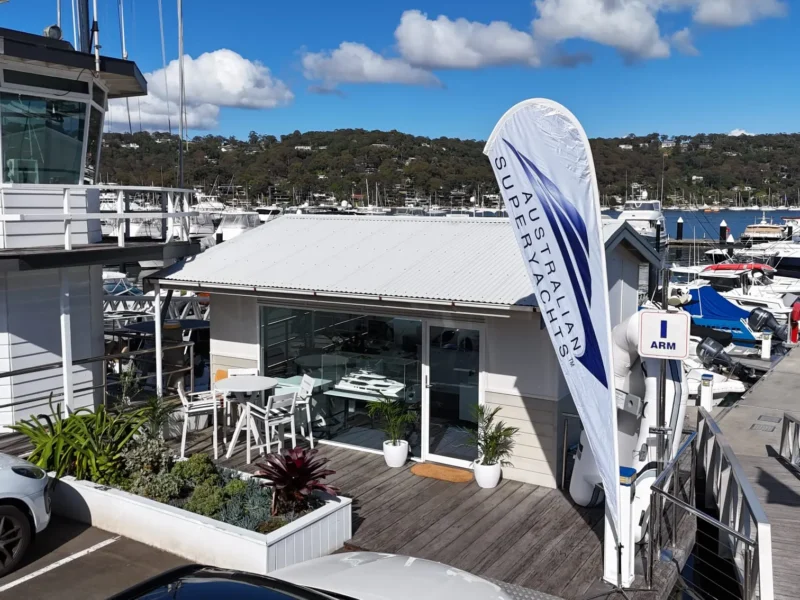
I am the founder and Managing Director of Australian Superyachts Pty Ltd (est. 1999), a superyacht port agency, vessel management and maritime compliance firm based at the Royal Motor Yacht Club, Newport, Sydney. A second-generation Master Mariner, I hold an AMSA Unlimited Master Mariner certificate, am an AMSA Accredited Surveyor and manage a number of vessels. From 1999 to 2009 I was contracted to the Waterways Authority and NSW Maritime, first as Project Manager for the Sydney 2000 superyacht program and then as manager of the Rozelle Bay Superyacht Marina. I still hold seagoing command of an Australian commercial ship in South Australia, which keeps me honest about today’s maritime regulations and procedures. Contact: richard@australiansuperyachts.com.au · +61 410 689 289.
Sources
-
Arthur Andersen, Super Yacht Accommodation: Assessment of Supply, Demand and Economic Benefits, prepared for SOCOG, final report July 1998 (author’s records)
-
Waterways Authority / NSW Maritime correspondence, press releases and annual report drafts, 1999 to 2009 (author’s records)
-
NSW Maritime reference for Richard Morris, Steve Dunn, Chief Executive, 3 July 2009 (author’s records)
-
AEC Group, Economic Impact of Superyachts in Australia, 2022, as presented for the Brisbane 2032 Marine Project
-
CharterWorld: Sydney Superyacht Marina and Campbells Cove Circular Quay (2 March 2012)
-
Ocean Magazine: Sydney Superyacht Marina, Silver Celebration
-
Seabreeze: Rozelle Bay Superyacht Marina to Grow (NSW Government figures)
-
SportBusiness: Sydney’s billion dollar Olympic boost (Arthur Andersen / CREA forecast, 1999)
-
Superyacht Australia LinkedIn posts, October 2026 (MY Odisea; Rugby World Cup 2027 trial proposal)