If charter income is part of your ownership plan in Australia, one requirement sits in front of everything else: your vessel must hold a current AMSA Certificate of Survey and a Certificate of Operation before it can operate as a Domestic Commercial Vessel. There is no way around this gate, and getting through it well is the difference between a yacht that earns and a yacht that sits.
This guide explains what commercial survey actually involves, what tends to catch owners out, and how to approach it so the process stays predictable in cost and time.
Why survey matters more in Australia than owners expect
Many owners arrive with a yacht built to a recognised international standard, the MCA Large Yacht Code or a Classification Society rule set, and assume that is enough. It is a good starting point, but Australia runs its own commercial vessel framework under the National Law, administered by AMSA. A vessel that is fully compliant elsewhere can still need work before it satisfies the National Standard for Commercial Vessels (NSCV).
The two certificates, explained plainly
- Certificate of Survey confirms the vessel itself, its construction, stability, equipment and safety systems, meets the standard for its intended commercial use.
- Certificate of Operation confirms the operator, the owner or their management company, is authorised to run the vessel commercially, and defines what the vessel may do, where, and with how many people aboard.
Both are needed. One without the other does not allow commercial operation.
What the process looks like, step by step
- Initial compliance assessment. Before anything is submitted, an honest review of where the vessel sits against the standard. This is where a realistic pathway, timeline and cost range get established. Skipping this step is the most common cause of surprises later.
- Survey planning and documentation. Stability information, construction details, equipment schedules and safety management documentation are assembled and reviewed. Usually the hardest part for a pre-owned superyacht is obtaining the approved construction drawings and certificates, and especially electrical schematics from the shipyard that built the yacht, if they still exist.
- Physical survey. An AMSA-accredited surveyor inspects the vessel. Depending on the vessel’s history and condition, this may involve out-of-water inspection.
- Rectification. Anything identified as non-compliant gets addressed. This is where costs can move, which is why the initial assessment matters so much.
- Certificate issue. Once the vessel and operator satisfy the requirements, AMSA issues the certificates.
- Ongoing compliance. Certificates require maintenance through periodic surveys and continued adherence to the safety management system.
What typically catches owners out
In my experience, some owners who bought superyachts overseas intending to operate them in Australia as commercial DCVs found, once the yacht arrived, problems that prevented it achieving survey. The causes were usually:
- Relying on a foreign yacht broker’s assurance that the vessel will meet Australian survey requirements, when the broker has no real knowledge of those requirements and is telling the client what they want to hear to close the deal.
- Assuming a Classification Society certificate transfers directly, without understanding the difference between Commercial Class and Recreational Class. Only commercially classed vessels can be considered.
- Buying the yacht unseen, relying on a surveyor appointed by the selling broker for the condition survey rather than one appointed by the owner.
- Stability documentation that doesn’t match the vessel’s current configuration after a refit.
- Fire safety or means-of-escape arrangements that meet one standard but not the NSCV.
- Electrical installations built to standards that do not comply with Australian Standards.
- Underestimating the timeline, particularly when yard work is needed before survey.
Every one of these could have been avoided if the buyer had engaged an AMSA Accredited Surveyor with superyacht experience to inspect the vessel before purchase and assess its suitability for DCV commercial compliance. That pre-purchase assessment is exactly what we provide.
Timeframes and cost, honestly
The only way to establish the real cost and timeline of importing a superyacht and bringing it into Australian DCV compliance is to have an AMSA Accredited Surveyor attend the vessel and produce an assessment, ideally before you commit to the purchase.
Track record
Australian Superyachts has taken both existing yachts and purpose-built new builds into Australian commercial survey. In the class notation below, the number is the vessel class (Class 1 may carry more than 12 passengers, Class 2 up to 12) and the letter is the operational area, from E (smooth waters) to C (restricted offshore).
Existing yachts converted to commercial survey
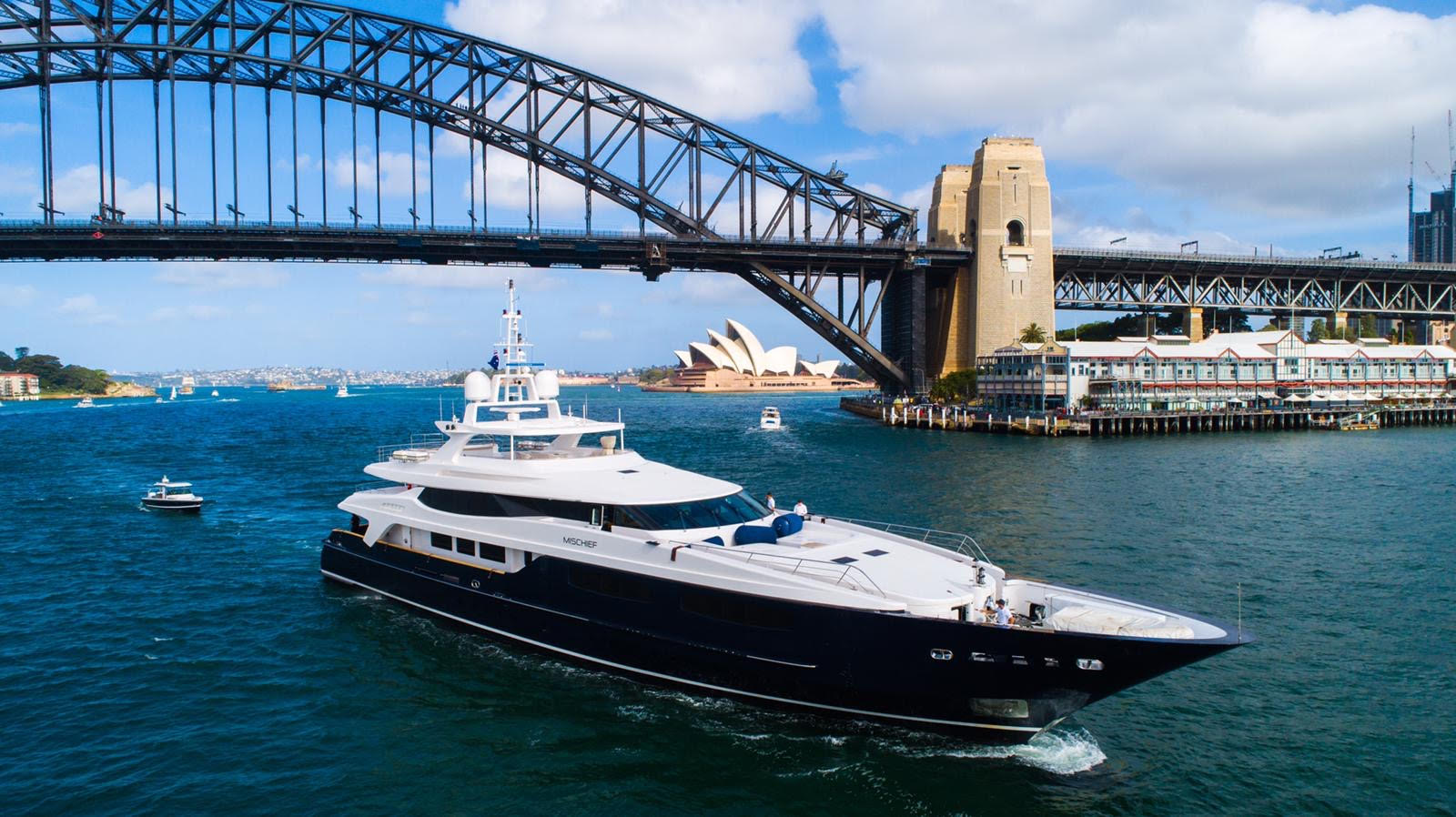
- M/Y Mischief (54 m): imported in 2019 and taken into commercial survey for up to 200 guests plus crew.
- M/Y Patriot 1 (34 m, Lloyd’s Ships): taken into survey under full management, achieving NSCV 1D and 2C in November 2014.
- M/Y Element (25 m, Warren Yachts): full oversight and project management to NSCV 1E and 2E.
- M/Y Stealth, now operating as M/Y Shadow (23 m, Warren Yachts): engaged by the owner to achieve NSCV 1E survey in 2014.
New builds delivered into survey
- M/Y Ghost II (37 m, Majesty 122): built to Australian commercial standards for the Sydney charter market. She achieved survey within seven days of arriving in 2016, ran her first charter on the eighth day, and carries up to 120 guests.
- M/Y Oneworld (32 m, Majesty 100): delivered in 2018 for up to 105 guests.
- M/Y Altavita (40 m), M/Y Legacy (32 m) and M/Y Bluestone (30 m).
Get an honest assessment first
Before committing to a timeline or a budget, get a proper initial assessment from someone who has done this many times. It is the single best investment an owner can make in the process.
Download this guide as a PDF, or discuss your vessel with our AMSA Commercial Survey team.