By Captain Richard Morris, Managing Director, Australian Superyachts
In my last piece for Ocean I said the biggest risk to Brisbane 2032 wasn’t berths, money or the tide in the Brisbane River. It was interstate rivalry. I stand by that. But berths are the next problem on the list, and the river makes them a hard one.
Superyacht Australia’s economic modelling says Brisbane 2032 could bring more than 200 extra foreign superyachts to Australia. Sydney had about 40 in 2000, and I had to find a home for every one of them. So I know what it means to plan for 200.
Most of those yachts will want to be in the river, close to the city. The river doesn’t have room for them. The obvious answer is to build new superyacht marinas. I think that would be an expensive mistake.
A river that doesn’t want marinas
The Brisbane River is a beautiful place to show off a yacht and a terrible place to build a marina. Three things work against it.
The tide. At the Port Office gauge in the city the river rises and falls by around two and a half metres at springs, twice a day, and the tide runs all the way up to Mount Crosby. Every pontoon, gangway and pile has to live with that.
The floods. The city gauge peaked at 5.45 metres in 1974, 4.46 metres in 2011 and 3.85 metres in 2022. The 2011 flood tore the floating Riverwalk loose and destroyed seven ferry terminals. Rebuilding them cost up to $145 million, and the new Riverwalk is fixed on 37 concrete piles because the floating one didn’t survive. In 2022 the river was reported running at 12 to 14 knots, and Maritime Safety Queensland pulled about 7,000 tonnes of debris out of it, much of it pontoons and boats that broke free.
The ships. Even big ships on proper wharves struggled in 2022. In February the 185 metre tanker CSC Friendship parted her lines at the Ampol wharf and grounded downstream. In May two container ships broke away at Fisherman Islands. The Australian Transport Safety Bureau found the risk was foreseeable and that nobody had a structured plan for it.
Then there are the bridges. The Story Bridge gives 30 metres of clearance. Many of the yachts that will come are taller than that, so the best city reaches upstream of the bridge are closed to them.
Now imagine a new superyacht marina in that river. It costs tens of millions of dollars to build. It has to survive a 1974-size flood for fifty years. It fills for two weeks in 2032. Then it sits half empty, and every wet season someone at council wonders whether it will still be there in the morning. That is not a legacy. It is a liability.
London had the same problem and solved it with buoys
The Thames is the closest match to the Brisbane River I know. Both are tidal rivers that wind through the middle of a big city. Both have strong currents, limited bank space, a working port downstream and bridges that stop tall ships. Both have a long history of flooding. The Thames tide is bigger, around seven metres at springs at London Bridge. Brisbane’s floods are worse.
London 2012. The Port of London Authority started planning more than a year out. In February 2011 it announced extra moorings on the tidal river from Tower Bridge down to Greenhithe, laid and run by licensed third parties. Owners had to book ahead, and river taxis would get crews ashore from the midstream moorings. The Chief Harbour Master put it simply: “The last thing we want is for boats milling about on the Thames with nowhere to moor up.”
The biggest yachts went into West India Dock at Canary Wharf, an enclosed dock behind lock gates. It was set up for 15 yachts up to 175 metres, at up to £9,000 a day. The 126 metre Octopus tied up there on 20 July 2012, with Ilona, Seanna and others. Cruise ships became floating hotels for 2,000 Games workers at King George V Dock. Fourteen tall ships berthed at Woolwich, and the PLA registered more than 1,100 vessels in its security identification scheme.
What Brisbane can take from it. Brisbane has no enclosed docks, so the West India Dock answer isn’t open to us. Everything else is. Book the moorings early. License experienced operators to lay and run them. Put water taxis on. Use cruise ships as floating hotels if the city runs short of beds. And register every vessel in one scheme so security knows who is on the river.
London today. The river moorings outlived the Games. Superyachts now lie on the tiers just below Tower Bridge, in front of Butler’s Wharf, with the City behind them. The 122 metre Kismet moored at St George’s Tier in 2026, and has come back every October since 2024, timed for her owner’s NFL team playing in London. The 98 metre Aviva and 74 metre Elandess lay opposite each other in front of Tower Bridge during Wimbledon. The 78 metre Odisea stopped near the bridge in March 2026, days after delivery. The Tower Bridge Upper mooring takes vessels up to 158 metres, and the Greenwich Ship Tier holds cruise ships on a line of six buoys.
The pattern will be familiar to anyone in Brisbane. The yachts come for the big events, sport above all, and they want to be in the middle of the city when they do.
No marina was built. Nothing permanent sits in the river except the moorings themselves. And the photo below, a superyacht on her buoys with Tower Bridge behind, is worth more to London’s brand than any marina brochure.
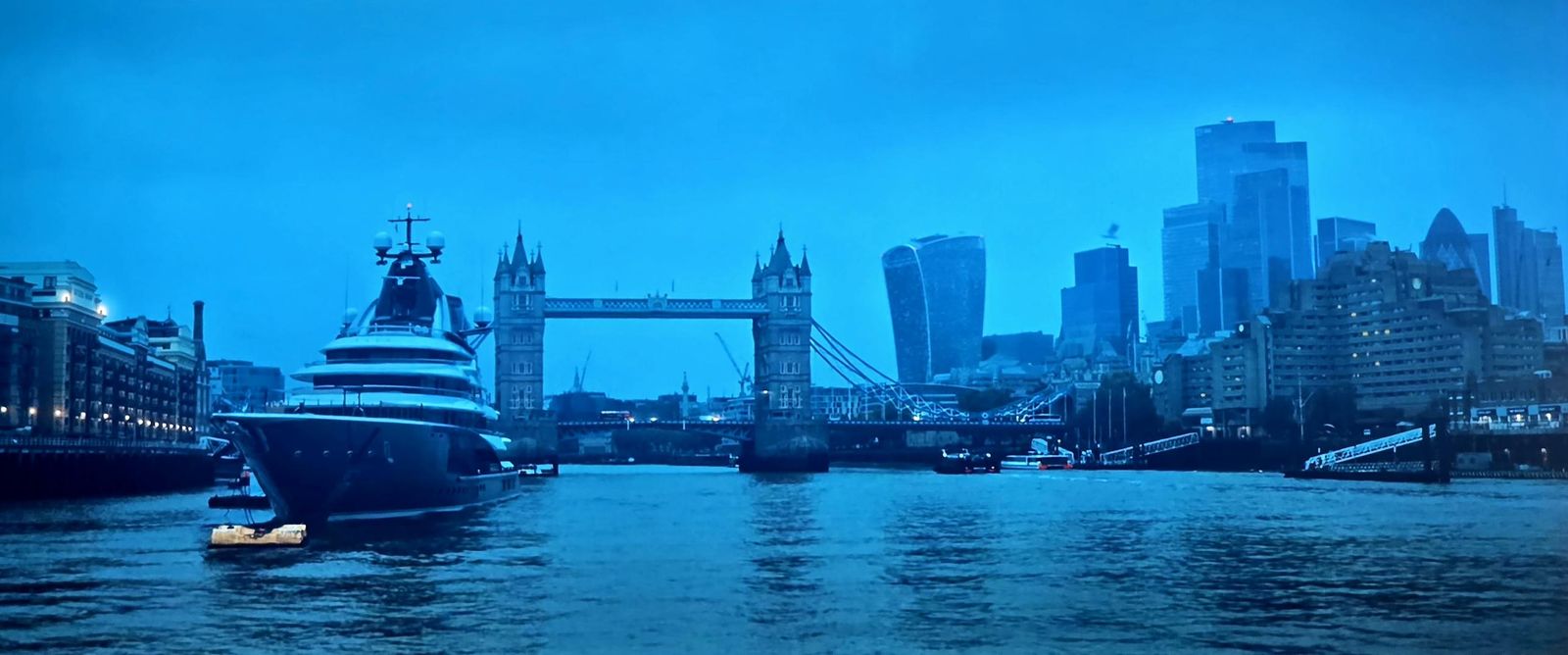
The 122 metre Kismet on the river moorings below Tower Bridge. Image: screenshot from the HBO series War (2026).
This is what a Thames mooring looks like. Two big yellow buoys, one off the bow and one off the stern, hold the yacht head-on to the current. A floating pontoon comes alongside as the landing for tenders and guests. Nothing is built on the bank.

The 98 metre Aviva, with her stern line running to a yellow mooring buoy, and the 74 metre Elandess on the moorings opposite. Photo: Raphaël Laloux.

Aviva on the moorings, Butler’s Wharf behind her. Photo: Raphaël Laloux.
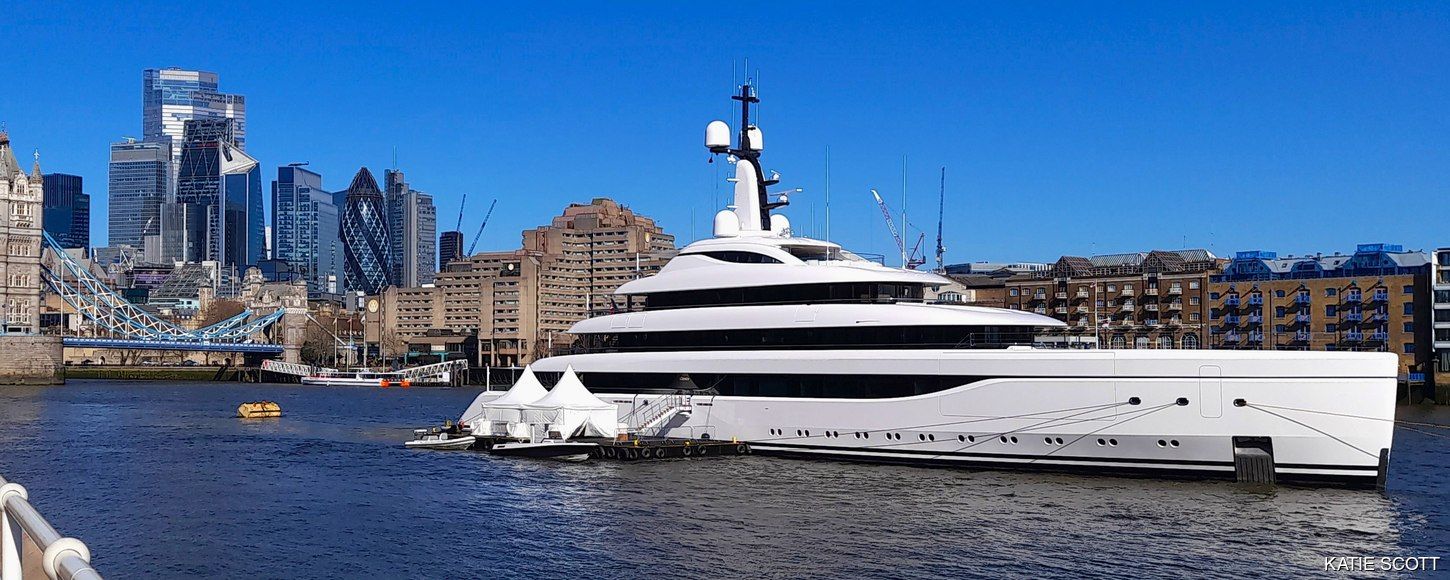
Odisea below Tower Bridge, March 2026, with a pontoon and marquees alongside. Photo: Katie Scott.

A superyacht moored on buoys in the Pool of London, with Tower Bridge and the City behind.

Kismet on the moorings at night, with her pontoon, marquees and a launch alongside.
How London runs it
The Port of London Authority is the harbour authority for the whole tidal Thames. It doesn’t run a marina business. It runs a river, and the moorings are part of how it manages the river. The model has five parts.
-
Fixed places in the river. The moorings sit at set positions, called tiers, chosen to keep the fairway clear. Each is charted, with its depth and the largest vessel it will take.
-
Bow and stern, not alongside. A yacht is held fore and aft between buoys, lying head-on to the current. She doesn’t range against a wharf, so the tide has nothing to grind.
-
One set of rules. The PLA publishes a code of practice for the safe mooring of vessels. It covers who maintains the moorings, how often they are inspected and what a vessel must do when the river turns nasty.
-
Commercial operators on top. Booking, line handling and launches are done by private operators and agents. Firms like Livett’s look after superyachts on the Thames with launches, crew transfers and shore logistics.
-
Pilots and bridges. Pilots bring large vessels up the river, and Tower Bridge opens for tall ones on notice. Everything is booked through one authority.
The point is that the infrastructure is cheap and the system is what does the work. A mooring is a block on the bottom, a chain and a buoy. The value is in the rules, the people and the booking, and all of that is software, not concrete.
Where the moorings in the Brisbane River could go
The bridges decide where each yacht goes, so sort the fleet by air draft. Coming in from Moreton Bay, a yacht meets these overhead limits.
| Crossing | Clearance above HAT | What it means |
|---|---|---|
| Sir Leo Hielscher (Gateway) Bridges | 57.4 m at the centre, 54 m at the edge of the navigation envelope | Yachts over 48 m air draft need the Regional Harbour Master’s permission. Between 53.5 and 56.4 m, tidal and transit restrictions apply. Taller yachts moor below the bridges |
| Bulimba power lines | 41.4 m | Over 38 m air draft needs written permission from the Manager, Vessel Traffic Services. Taller yachts can’t reach Shafston Reach |
| Story Bridge | 30 m | Over 28 m air draft needs the Regional Harbour Master’s permission. Yachts under 30 m can go on into Town Reach |
| Kangaroo Point Green Bridge | 12.3 m | The upstream limit of Town Reach for superyachts |
| Captain Cook Bridge | 12.7 m | Small craft only from here up |
Clearances from Maritime Safety Queensland, Brisbane Port Procedures and Information for Shipping, section 15.5, Table 23 (August 2024 edition), measured above highest astronomical tide.
That sorts the fleet into three mooring areas, plus the port for the biggest yachts.
-
A. Town Reach, under 30 metres air draft. These yachts pass under the Story Bridge and moor in Town Reach between the Story Bridge and the Kangaroo Point Bridge, in the heart of the CBD off Eagle Street and Riverside. Tenders land at Eagle Street and Riverside. Yachts over 28 metres need the Harbour Master’s permission to pass under the Story Bridge.
-
B. Shafston Reach, 30 to 41.4 metres. East of the Story Bridge, off Howard Smith Wharves and Kangaroo Point, with the cliffs and the city behind them. Yachts over 38 metres need written permission from Vessel Traffic Services to pass under the Bulimba power lines. Bulimba Reach takes the overflow, with tenders at Teneriffe and Bulimba.
-
C. Upper Hamilton Reach, 41.4 to 56.4 metres. Yachts too tall for the power line in Bulimba Reach lie between Bulimba Point and Portside. Any yacht over 48 metres needs the Harbour Master’s permission to pass under the Gateway Bridges, so these bookings go through early. Tenders land at Portside and Northshore Hamilton. Downstream of Portside the river becomes the ship channel, and the MSQ guide marks anchoring as prohibited, so the field must stop short of it.
-
R. Rivergate Marina and The Yard Brisbane, side by side just below the Gateway Bridges at Murarrie and Hemmant. Rivergate already has a customs and quarantine berth, a fuel and sewage pump-out facility and a shipyard. The Yard is a large refit and repair yard with heavy lift, refit sheds and about 30 marine businesses on site, and it is berthing superyachts too. Together they are the natural clearance, service and refit base.
-
T. Below the Gateway Bridges. Yachts too tall for the Gateway Bridges should be on buoys too, in the reaches just below the bridges where barges already lie on moorings. Nobody wants a superyacht in a commercial berth, and taking guests and crew through an ISPS-secured port terminal is a drama nobody needs.
Depth isn’t the problem. The charts show plenty of water mid-river for any yacht that can get under the bridges.
| Area | Air draft | Charted depths mid-river | Watch for |
|---|---|---|---|
| A. Town Reach | Under 30 m | 6.8 to 7.7 m, 15.5 m off the Story Bridge | Shallows under 4 m along both banks, ferry terminals and the MSQ emergency mooring |
| B. Shafston Reach | 30 to 41.4 m | 8.2 to 20 m | A charted obstruction with 6.4 m over it towards Kinellan Point |
| Humbug Reach | 30 to 41.4 m | 6.6 to 18.4 m | The existing anchorage off New Farm Park |
| B. Bulimba Reach | 30 to 41.4 m | 6.9 to 9 m | The 41 m power line at the Bulimba end |
| C. Upper Hamilton Reach | 41.4 to 56.4 m | 6.9 to 11.5 m | Shoals under 1.5 m on the south side, and the ship channel downstream |
Depths from electronic charts, measured down from chart datum (lowest astronomical tide). At any state of the tide above LAT there is more water than shown.

Likely mooring areas, indicative only. Clearances from MSQ Port Procedures, section 15.5 (August 2024). Map data © OpenStreetMap contributors.
Most of the river hasn’t been surveyed since the 2011 and 2013 floods. So, the first job is a full hydrographic survey of every mooring area now, and another close to the Games.
The charts
These four pages from Maritime Safety Queensland’s Beacon to Beacon Guide cover the river from the city to the mouth: Town Reach and the CBD (BR-4), Shafston, Humbug, Bulimba and Hamilton Reaches (BR-5), the Gateway Bridges, Rivergate and The Yard (BR-6) and the river mouth (BR-7). They show the navigation tracks, the ship channel, the anchoring prohibited area and the overhead clearances.
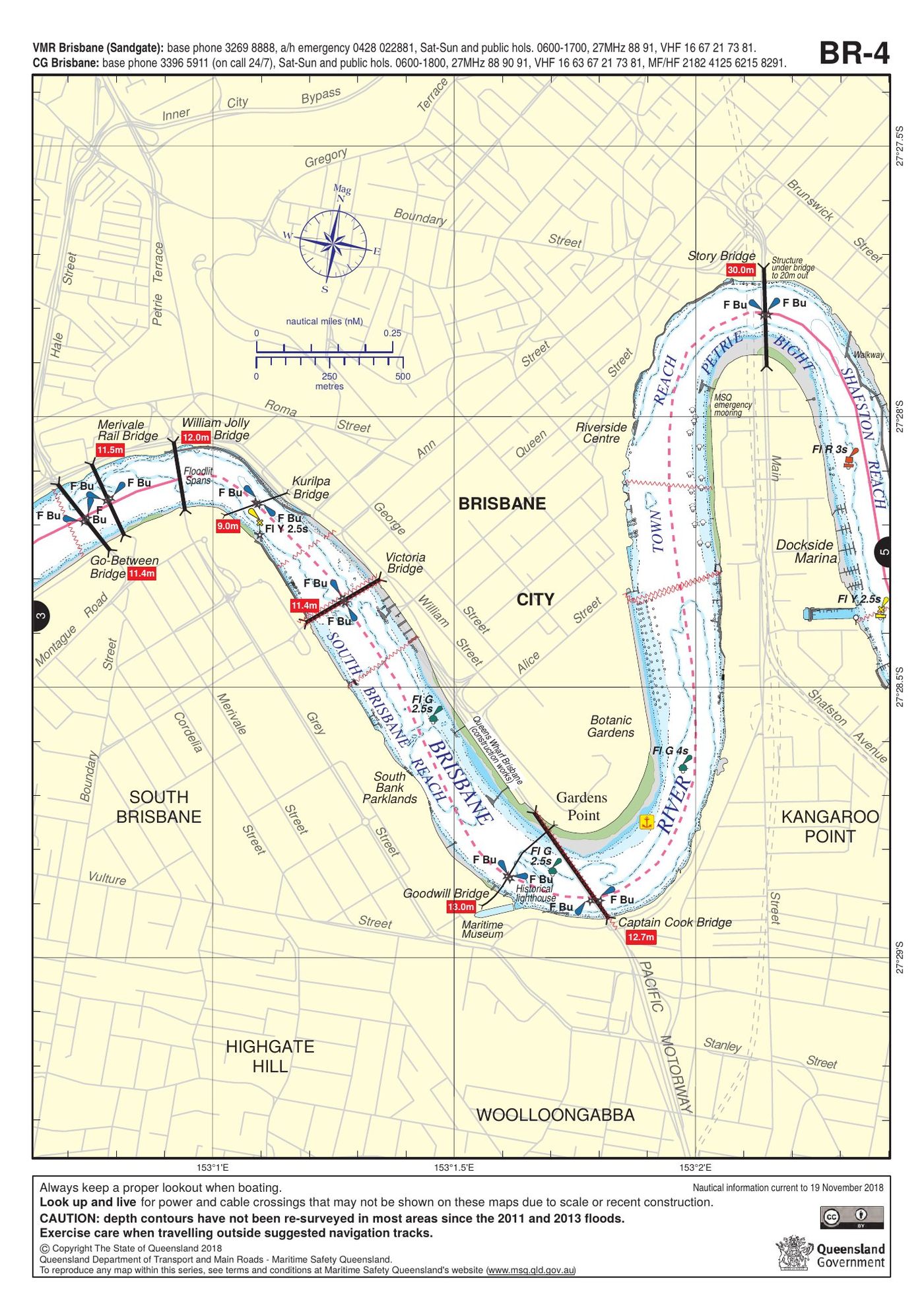
BR-4: Town Reach, the CBD and Kangaroo Point, up to the Story Bridge. Source: Maritime Safety Queensland, Beacon to Beacon Guide, Brisbane River and Bremer River. © The State of Queensland 2018. Not to be used for navigation.
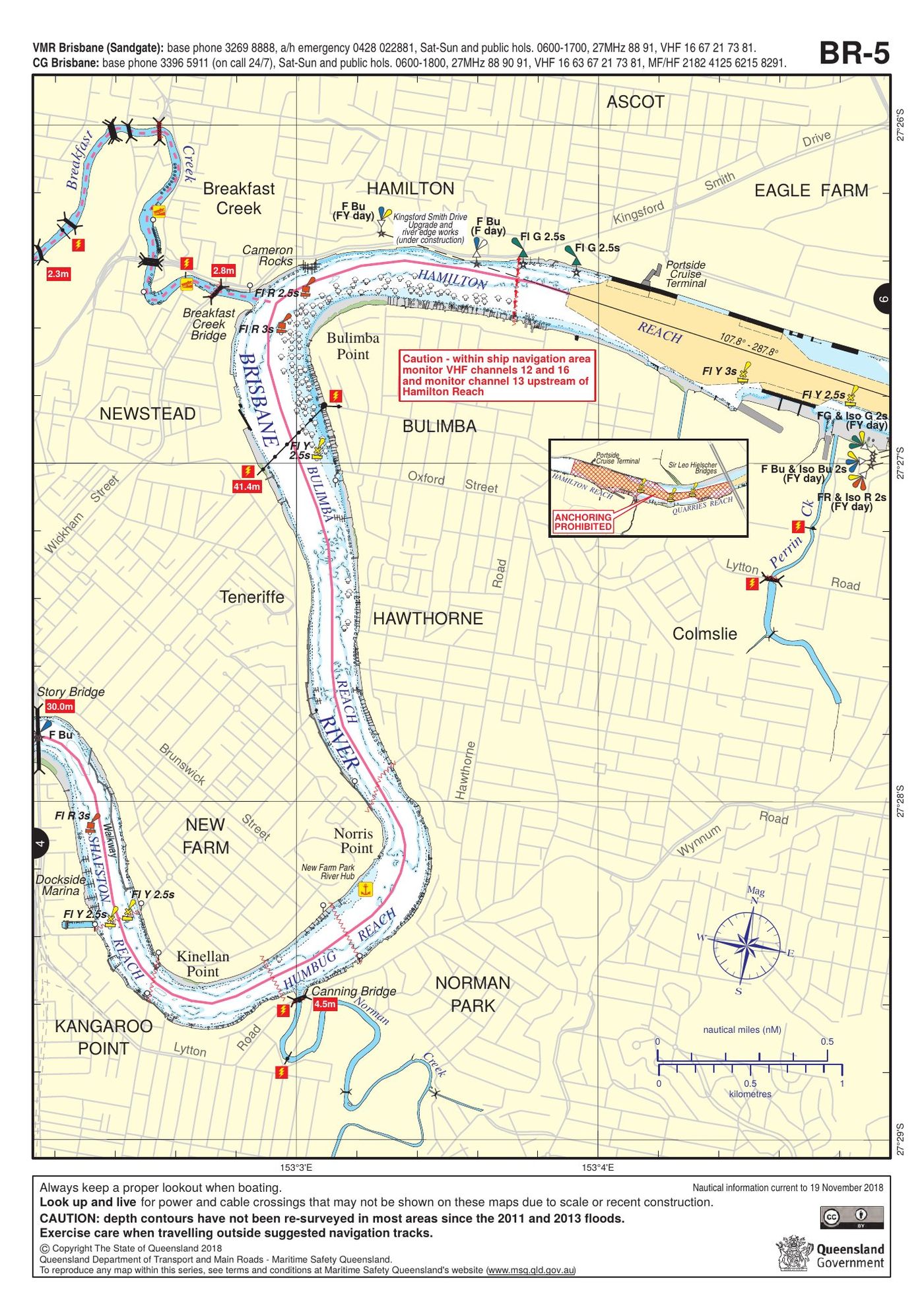
BR-5: Shafston, Humbug, Bulimba and Hamilton Reaches, with the Bulimba power lines. Source: Maritime Safety Queensland, Beacon to Beacon Guide, Brisbane River and Bremer River. © The State of Queensland 2018. Not to be used for navigation.
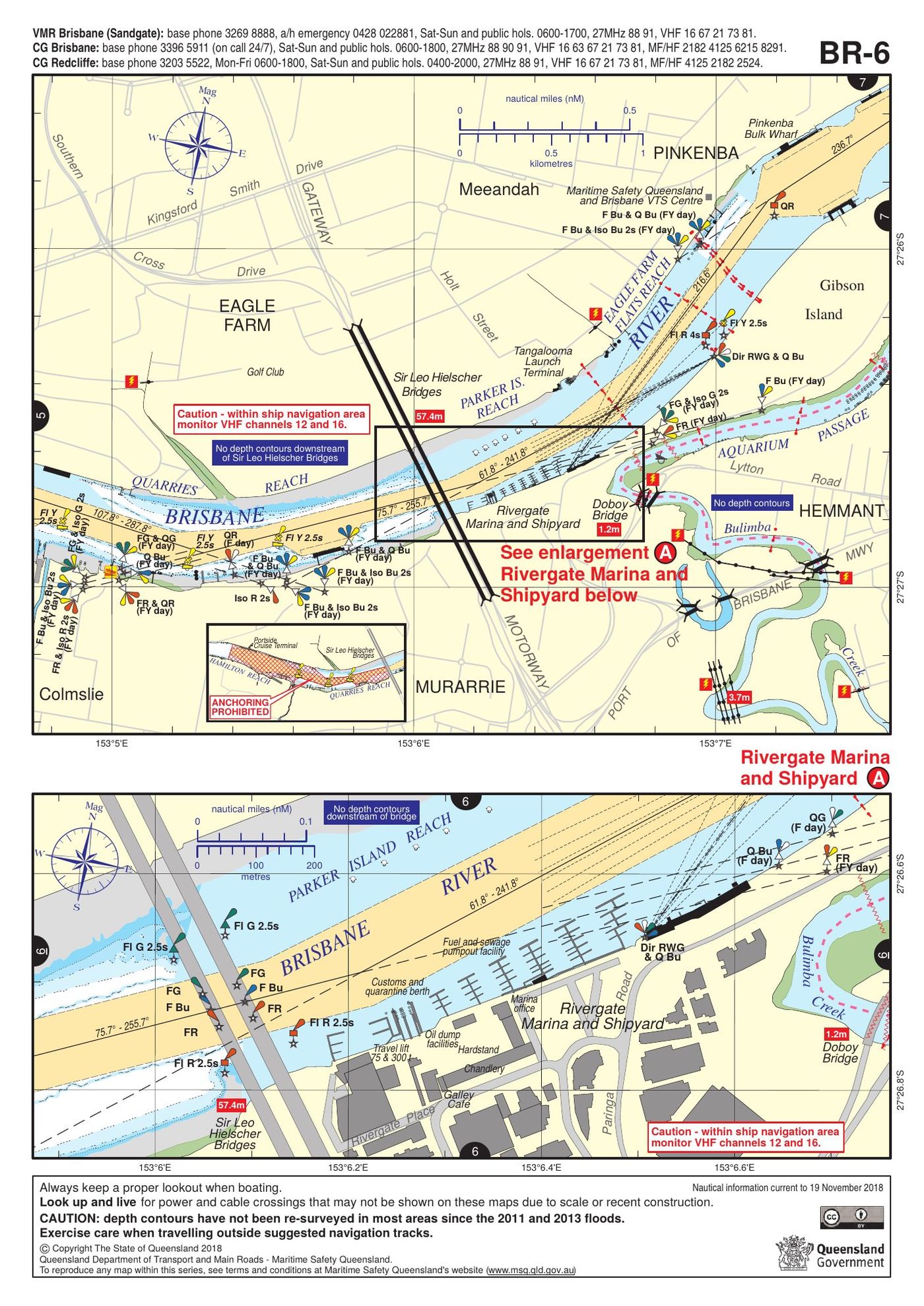
BR-6: Portside, Quarries Reach, the Gateway Bridges and Rivergate. Source: Maritime Safety Queensland, Beacon to Beacon Guide, Brisbane River and Bremer River. © The State of Queensland 2018. Not to be used for navigation.
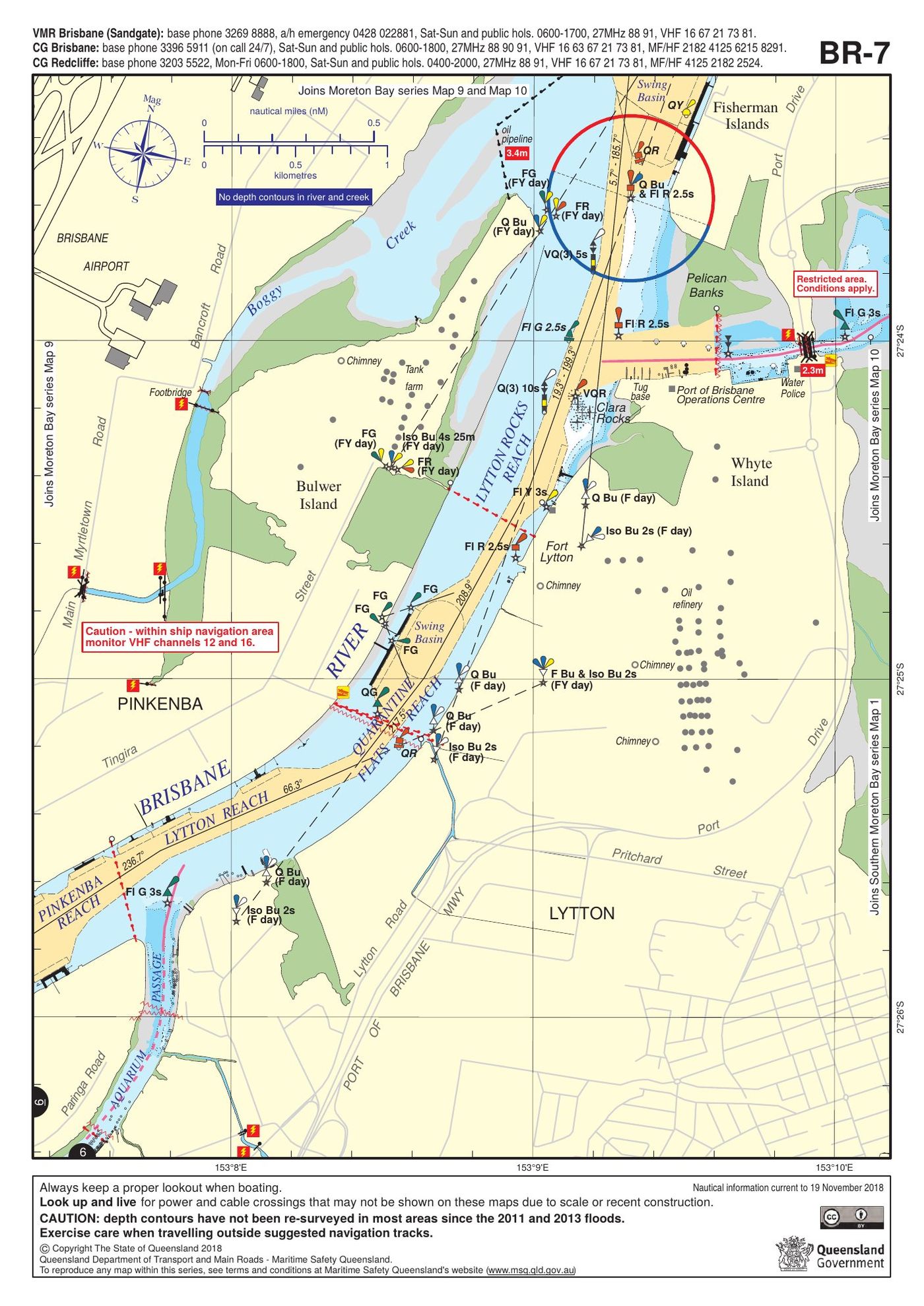
BR-7: Pinkenba to the river mouth and Moreton Bay. Source: Maritime Safety Queensland, Beacon to Beacon Guide, Brisbane River and Bremer River. © The State of Queensland 2018. Not to be used for navigation.
Download: MSQ Beacon to Beacon Guide, Brisbane River charts BR-4 to BR-7 (PDF, 1.6 MB)
What Brisbane should do
Lay a field of fore and aft moorings in the river for the Games, run it like the Thames and lift most of it when the Games are over. Here is how I would do it.
Queensland has been here before. In December 2018 a 74 metre superyacht spent a day in the City Reach, arranged by Rivergate with Maritime Safety Queensland and the Harbour Master. Rivergate called it “an historic event”. Then in March 2020 the Queensland Government announced a 12 month trial of a dedicated superyacht buoy mooring below the Kangaroo Point cliffs, for yachts of 24 metres and over. MSQ would manage bookings, fees and maintenance. The minister said: “We want them to stay longer and spend more while they are here.”
The trial never happened. COVID-19 stopped it, and the site clashed with the Kangaroo Point Bridge, which now crosses the river there. MSQ still says the buoy mooring work will resume. Brisbane 2032 is the reason to resume it, and on a bigger scale.
-
Pick the reaches now. Survey Town, Shafston, Bulimba and upper Hamilton Reaches for depth, holding ground and clearance from the shipping channel. Match each area to the air drafts it can take.
-
Lay heavy, simple moorings. Concrete blocks, chain and buoys, sized to suit the yachts in each area, typically 10 to 20 tonnes, and laid by an experienced mooring contractor. Each yacht lies between two buoys, bow and stern, head-on to a current of around 1.5 to 2.5 knots, depending on springs and neaps.
-
Make them temporary. Lay them in 2031, test them through a wet season and lift most of them after the Games. Keep a handful as permanent visitor moorings. Leave the river as we found it.
-
One authority, one desk. Maritime Safety Queensland and the Port of Brisbane set the rules, a code of practice like London’s. One booking desk allocates every mooring. Agents and launch operators do the rest.
-
Plan for the flood before it comes. The 2022 breakaways taught us that the risk is foreseeable. Every yacht on a river mooring signs up to a flood plan. When the Bureau of Meteorology issues a warning, the yachts slip and go down to Moreton Bay under pilot. A yacht on two buoys can leave in an hour. A marina can’t.
-
Use what is already on the bank. Tenders land at existing ferry terminals, wharves and pontoons, which were rebuilt after 2011 to survive a 1-in-500-year flood. Brisbane already has the shore side. It only needs the river side.
The moorings would cost a fraction of one new marina. They would put superyachts in the middle of the city, where the cameras are, not in a basin out of sight. Each yacht would lie on her own, with clear water on every side, not hemmed in like in a marina. And there is almost nowhere left on the river to build a marina anyway. And they would leave nothing in the river for the next flood to tear loose.
The yachts need servicing, and that is the opportunity
A superyacht on a buoy is a small town with no pipes to shore. Everything she needs comes to her by water, and everything she makes has to leave the same way. In the Brisbane River that is a bigger job than in most harbours.
-
Fresh water by barge. Superyachts make their own water. Not in the Brisbane River. The water is brown with silt and runoff, and most engineers won’t run a watermaker on it and risk clogging the membranes. A big yacht with guests aboard goes through a lot of water, and every litre of it will have to come by barge, or by road tanker and hose where a yacht lies close enough to the bank. Either way it’s steady revenue for whoever supplies it.
-
Sewage out by barge. Queensland treats rivers as smooth waters. Untreated sewage can’t be discharged from any vessel, so holding tanks will need pumping out on a schedule, by pump-out barge, to an approved facility. There is a better answer worth chasing. Most superyachts carry IMO-approved sewage treatment plants, and MSQ’s own fact sheet says Grade A treated sewage can be discharged anywhere except prohibited discharge waters. Approval for yachts with approved plants to discharge treated effluent on the ebb tide could cut the barge work right down. That can be settled closer to the Games.
-
Fuel. Bunkering by barge on the mooring, or at Rivergate’s fuel berth.
-
Garbage and recycling. Collected from the yacht, sorted and landed under biosecurity rules for international waste.
-
Launches and water taxis. Guests, crew, provisions and contractors all move by water. London had river taxis on from the start in 2012, and Brisbane will need the same.
-
Mooring parties and line handling. Every arrival and departure on two buoys needs a mooring boat and a crew who know the river and its currents.
-
Tugs. Most yachts can be moored with launches taking the lines to the buoys. Two small, tidy tugs with careful tug masters should be on call for the larger yachts, and wherever the rules require one by size.
-
VIP pontoons. Each yacht needs the option to have a floating pontoon alongside as her front door, fendered on both sides for the yacht and her tenders. These have to be VIP quality, not a barge with fresh paint. A standard steel design, built in numbers by a Queensland fabricator, would be cheap to make and good business.
-
Provisioning, laundry, florists and contractors. All delivered by launch.
-
Security and guard boats. Around high-profile yachts, all day and all night.
-
Customs, biosecurity and immigration. Rivergate has a customs and quarantine berth, but many of these yachts won’t fit on it. Better to have Border Force and biosecurity officers come out by launch as soon as each yacht is moored safely on her buoys.
-
Refit and repairs. Rivergate and The Yard Brisbane can lift, repair and refit yachts before or after the Games.
None of this needs a new marina. It needs barges, launches and people. That is good business for Queensland operators: boat builders and barge owners, water carriers, waste contractors, launch operators, provedores and agents. And unlike a marina, the skills stay in the city after the Games.
Moor them like London
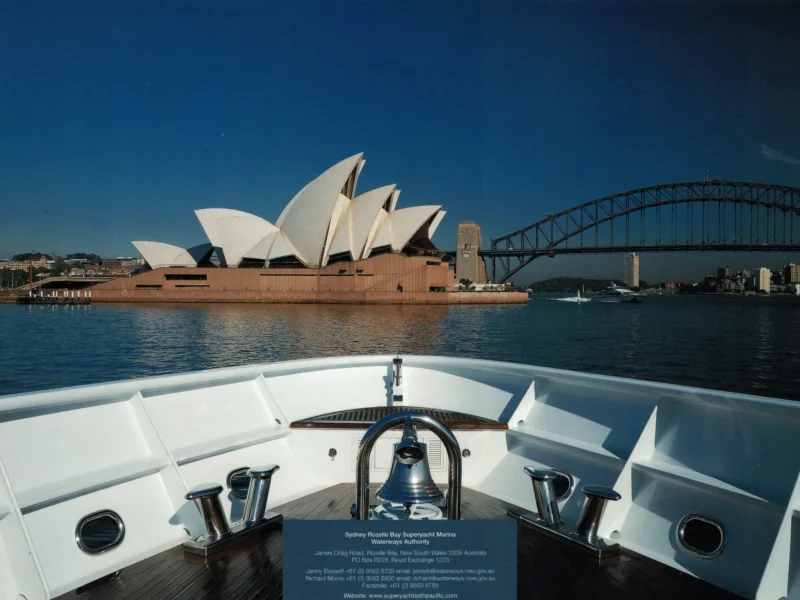
In 2000 Rozelle Bay was meant to be temporary. We made it work, the yachts kept coming, and it is still running, at maximum capacity, 26 years later. Brisbane can do the same thing for a fraction of the cost, without fighting the river.
Put the yachts in the river, on buoys, bow and stern, in front of the city. Write the rules once. Have a flood plan. Lift the blocks when it’s over. London has done it for years with a bigger tide. Brisbane can do it in 2032 and beyond.
And if Queensland wants help laying it out, NSW has done this before. The offer still stands.
Captain Richard Morris is the founder and Managing Director of Australian Superyachts, a port agency, vessel management and compliance firm he started in 1999. He ran the superyacht program for the Sydney 2000 Olympics as Project Manager and then General Manager of Rozelle Bay Superyacht Marina. He holds an AMSA Unlimited Master Mariner certificate, is an AMSA accredited surveyor and still holds seagoing command.